FOOH in one sentence
FOOH stands for faux out-of-home, or fake out-of-home: an ad that imitates a billboard or an installation in public space but only exists on video. Glossy defines it as hyper-realistic, augmented reality or CGI-based digital ads that appear as real-world out-of-home activations (Glossy, 2023).
In practice, a FOOH film shows a real, recognisable place, then adds a product or an installation at a scale, or in a situation, that could never exist. The film is published on social media. There is no billboard, no street furniture and no street-occupation permit: the stunt only exists in the video.
Two viral examples from 2023
Jacquemus, April 2023. An 8-second Instagram clip shows Bambino bags on wheels cruising the streets of Paris. Many viewers wonder whether it is AI, CGI or a real installation. It is CGI: 3D artist Ian Padgham modelled the bag and composited it into footage of the city (Paper, 2023).
Maybelline, July 2023. The brand posts short films for two mascaras: in New York, a pink train styled like the Falsies Surreal packaging; the next day in London, a tube train and then a double-decker bus that seem to wear false lashes, for Sky High. The New York film passes 12 million views on TikTok within weeks. The campaign was created with video creator Ian Padgham (Beauty Packaging, 2023).
Why it works
- Surprise. You first recognise a real place, then discover something impossible: that gap stops the scroll.
- Doubt. At Maybelline, the stated goal was to get people talking and wondering whether it was real or not (Glossy, 2023).
- Sharing. A short film, often without words, understood in a second, travels from one country to the next without translation.
- Budget. The brand buys no billboard space and builds no installation: most of the budget goes into the idea and its making.
How a FOOH film is made today
The first FOOH films relied on a classic CGI pipeline: footage shot in a real place, camera tracking, 3D modelling of the product, then compositing the object into the shot. That is the method Ian Padgham described for Jacquemus.
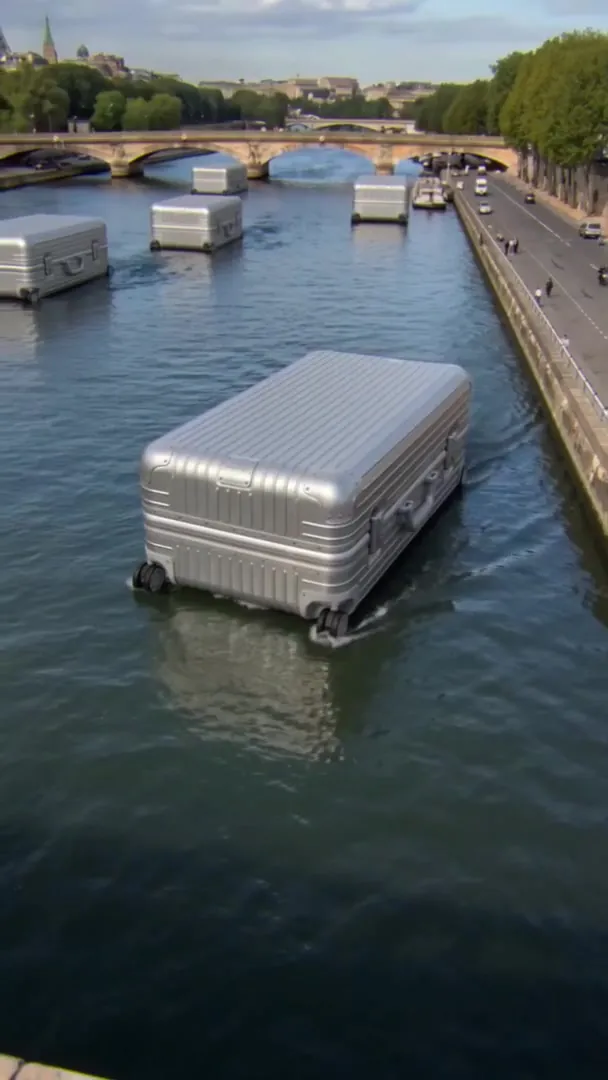
Generative AI opens another route: generate the whole scene, location included, then animate the product shot by shot. That is how we made our Rimowa Original Check-in films: a giant suitcase taking off from a runway, then a fleet of cases sailing down the Seine. Our process has four stages.
- The concept. One impossible idea, tied to what the product does. For a suitcase: travel, so it becomes the vehicle.
- The location. A place people recognise in a second: a landmark, an airport, a river, a famous street.
- Production. The scene and the product's movement are generated shot by shot, checking at every step that the product stays faithful.
- Finish. Sound, grading and logo in post-production, then cutdowns for each platform.
The rules to know
FOOH plays with doubt. That is its strength, and it is also what now exposes it to transparency rules.
- The EU AI Act. The transparency obligations in its Article 50 have applied since 2 August 2026 (Morgan Lewis, 2026). Professionals who use an AI system to produce a deep fake, meaning an image or video that resembles existing people, objects or places and could pass as authentic, must disclose that the content was generated or manipulated. For an evidently artistic, creative or fictional work, it is enough to disclose that such content exists, in a way that does not hamper the display of the work (Articles 3 and 50 of the regulation).
- Platforms. Since 2023, TikTok has required people to label AI-generated content that contains realistic images, audio or video (TikTok, 2023).
In practice, whenever it could pass for real, an AI-made FOOH film published in the European Union is likely to fall under this obligation and must be labelled as such, for instance in the caption or with the platform's own label. These rules keep evolving: check them before each release. This article is not legal advice.
In short
A FOOH film is a real place, an impossible situation and a single idea, all designed for a phone. Generative AI makes it faster to produce, as long as the product stays faithful and the brand clearly labels the image as AI-generated.
Have a product that deserves to take off? Discover our FOOH service or write to us.