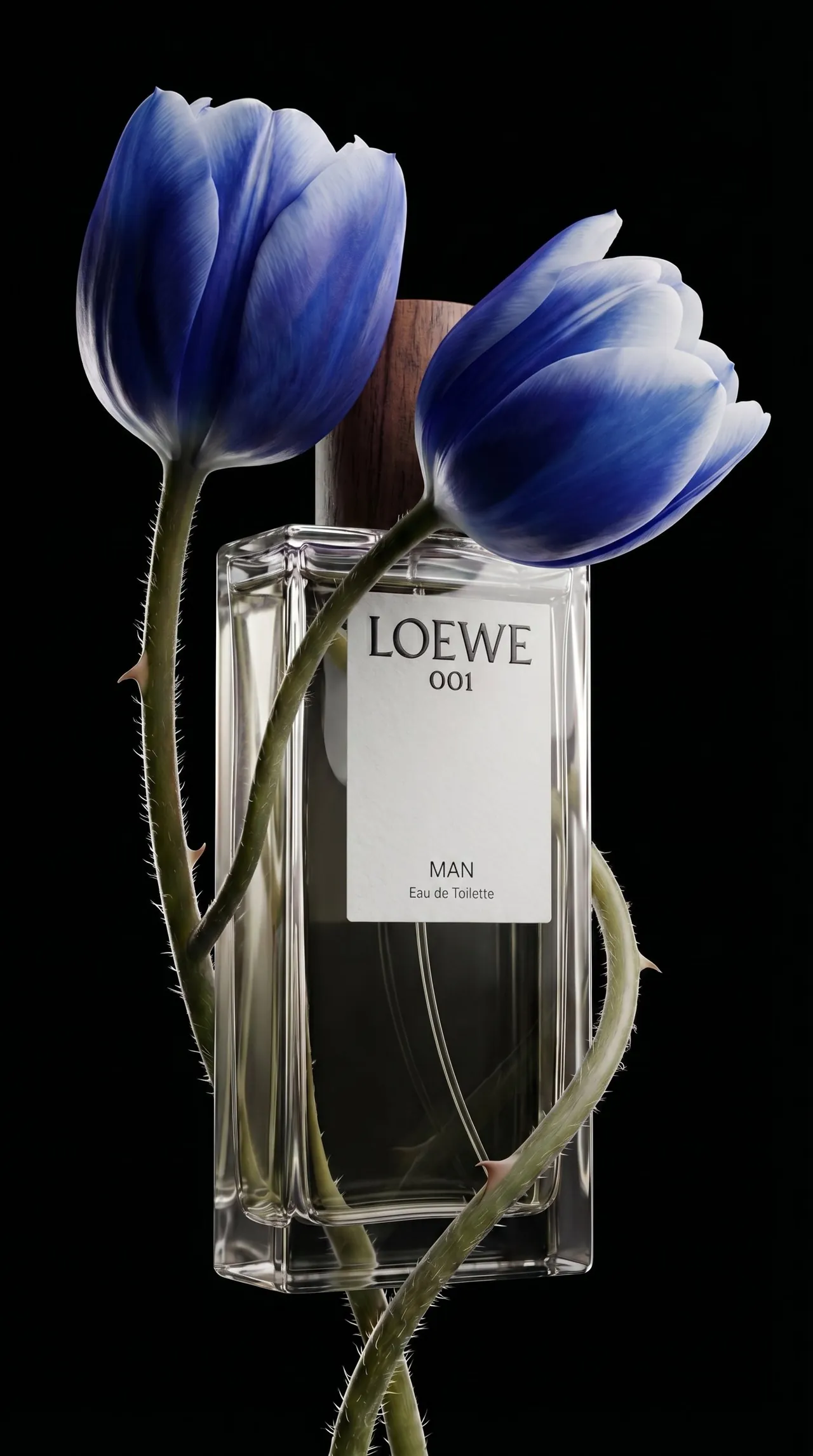
A fragrance campaign has to make people want to smell something they cannot smell through a screen. For a long time, the constraint came from production: a set, a light, a budget. Generative AI removes much of that constraint. Two harder ones remain: choosing the right world for the fragrance, and keeping the bottle perfectly faithful from one image to the next.
Our method has five steps. We illustrate it with our Loewe 001 Man project.
1. What the brand sends us
Everything starts with three elements.
- The bottle. Sharp packshots from several angles, plus the label and logo files. This is the reference every image will be compared against.
- The brief. Positioning, audience, launch calendar, planned uses (social media, website, retail, press) and the images to avoid.
- The composition. Top, heart and base notes, and the way the brand talks about the scent. This is the raw material of the art direction.
A precise brief on uses saves a lot of back and forth: you do not frame a vertical story the way you frame a magazine spread.
2. Read the fragrance before making images
Before producing a single image, we translate the fragrance into visual decisions: materials, a light temperature, a palette, a rhythm. A fresh note can become a cold light; a warm note, a material you want to touch. A dry woody scent does not call for the same wood as a smoky one.
For 001 Man, the starting point was a contrast between softness and raw nature. We translated it into pairs of materials: petals against thorns, raw stone against clear glass, weathered wood against a clean label. Those pairs then guided every image in the series.
3. Three creative directions
We answer the brief with three directions, no more, no less. One would lock the brand into our first instinct; beyond three, the choice gets blurry.
Each direction is an intention: a short text that says what the image tells, and a few images that show the world, the light and the bottle's place in it. The three must be truly different. For the same fragrance, you might imagine a mineral direction, a botanical one and an architectural one.
The brand picks a direction and sends us consolidated feedback. This is where the most time is saved: nothing decided here will need fixing later.
4. A first series of 8 to 10 stills
Once the direction is approved, we produce a first series of eight to ten images. A series rather than a single image, because a campaign lives on several media and has to stay consistent: same light, same palette, same framing grammar.
This is also where product fidelity is won or lost. Image models can still round off a bottle's edge, change the shade of a cap, simplify a label or flip a letter. We compare every image with the packshots: silhouette, cap, label, logo, transparency of the glass. Anything that does not match is corrected before the brand sees the series.
The brand reviews the whole series and sends its feedback in one go. Grouped feedback gives a consistent series; image-by-image feedback often gives a series that falls apart.
5. Refine, adapt, animate
The last step turns the approved series into a campaign ready to publish.
- Refinement. Detail retouching, consistent light from one image to the next, exact text on the bottle.
- Formats. The ones planned in the brief: vertical for stories, 4:5 for the feed, landscape for the website or the press.
- Animation, as an option. The stills can become a short film or a loop for social media and in-store screens. Because the film starts from approved images, it keeps the look of the series. More on our AI product films page.
What the brand should prepare
To start fast, this is what we usually ask for:
- high-resolution packshots of the bottle, from several angles;
- the label and logo files;
- the fragrance pyramid and the way the brand talks about the scent;
- the planned formats and media;
- the references to avoid, as much as the ones that inspire;
- the launch date.
What AI does not replace
AI is ideal for worlds that are impossible or too costly to build: unreal scale, imaginary places, materials that do not exist. It does not replace everything. If the campaign relies on a real face or must show a real place as it is, a shoot remains the right tool.
The two combine well: a series of stills can serve as pre-visualisation and fix the light, sets and framing before the day of the shoot. That is what our AI art direction service is for.
Preparing a launch? Discover our AI campaign imagery or write to us with your bottle and your timing.